Personal reflections of Dr Jagroop Singh based on social media interactions during and in the immediate aftermath of the farmers protest. I am a student of self directed Sikh Studies without funding or conflict of interest.
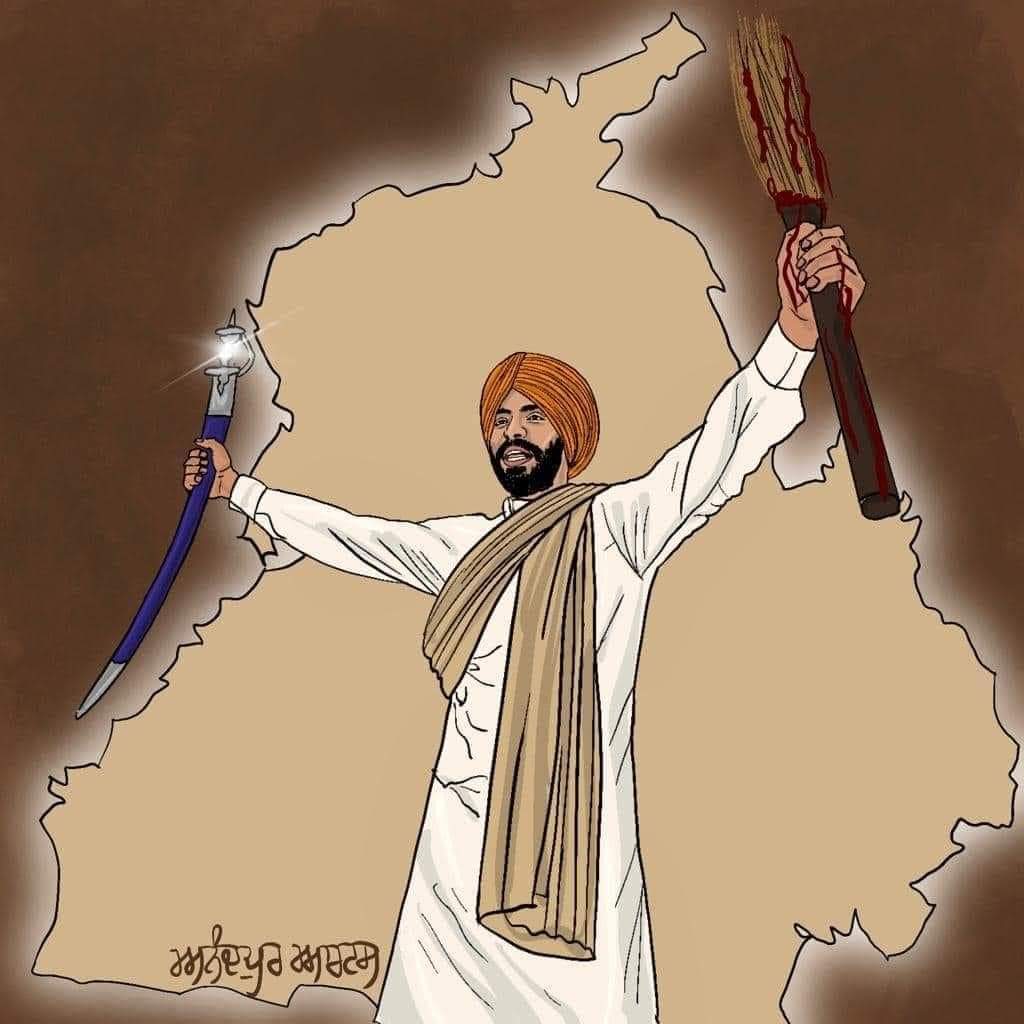
The adopted son of numerous Punjabi Mothers posed a question to the Qaum, as to where their loyalty lay and which political party represented Sikh values?
Following the ‘accidental’ death of Deep Bai the funeral was carried out within ‘24 little hours’, in his ancestral village. There was a massive outpouring of emotion amongst the thousands of people gathered in collective mourning. The reverberations of young people chanting “Deep teri soch te, Pehra dian ge thoke ke”, have caused a massive hit tothe political establishment, requiring some naval gazing. If evidence were needed, Sikh spirit is very much “alive and kicking” and even rejuvenated.
The immediate questions are: –
Who was Deep Sidhu?
What was his appeal?
How did he connect with the ‘hard to reach’ section of society?
What is the legacy of his ideas?
He was a larger than life character with background of being a lawyer, actor and more recently, an activist following an inner awakening. For most people, he came in to prominence during the farmers protest movement when he was a key protagonist amongst the younger participants to march towards Delhi (Dilli challo) from the Shumbu boarder. A video recording shows Deep Sidhu arguing with the police saying “ye inqilab hai, ye revolution hai” and “if they don’t understand the seriousness of this matter, it will define the political structure and the geopolitics of India as well as South Asia”.
The confident and articulate man with ‘Bollywood’ looks became a source of curiosity for MOJO story, a news platform on YouTube. Barkha Dutt’s interview (28 November 2020) can still be accessed and is reflective of the prejudicial opinion of the media. The feedback commentary reaped praise on the calm composure of the interviewee but picked fault with ‘failure’ of journalism. Barkha Dutt attempted to explore the apparent dissonance of an educated individual ‘standing in’ with peasant farmers. Deep said, “you don’t have to be a farmer to join the protest against the new farm laws”, asserting that his social conscience was the motivating force. The discussion went on to the Sikh identity/values being inextricably linked with the farmers and being a major contributor to this resistance movement. In fact this ongoing exploitation of farmers has a significant historical connection with the Anandpur Sahib Mata and what Bhindreranwale stood for. This was a step too far for Barkha Dutt who proceeded to impose her view of Bhinderanwale as a terrorist. Just as she tried to ‘shut down’ the discussion, Deep articulated that Bhinderanwale was a subject of a false Indian government narrative, a view substantiated in a recent book, “In service of Free India” (B S Pande 2021). The interview ceased on an unfinished and sour note without the usual respect or gratitude.
The relocation of the farmer protest from Shambu to the outskirts of Delhi resulted in some backbiting from the leadership, as they felt undermined. So much so, that he was barred from the main stage with calls for his ‘social boycott’. It got worse with rumours of him being a Bhartyia Janata Party (BJP) agent in view of his previous promotional links with Sunny Deol (BJP MP from Gurdaspur). Certainly his move from a comfortable life as an actor and lawyer to the rough and tumble of camping with ordinary farmers was a viewed with cautious suspicion and even cynicism. These sentiments were further reinforced when he was ‘blamed’ for the ‘deviation’ of the agreed route towards the Red Fort on 26 January 2021. He was singularly blamed for hoisting the Kesri Nishan Sahib and the green farmers flag next to the tricolour Indian flag. At this stage the leadership launched an avalanche of personal criticism of Deep being a Khalistani &/or Gadhaar (traitor) interested in derailing the protest. Cast off in full glare of publicity was extremely painful and a thorough test of his character and resolve. No political party, Panthic jathebandi or prominent personality came to his defence except for one, Ajmer Singh. He commended Deep’s honest sentiments whilst acknowledging his political naivety but thoroughly rebuked the farmer’s leadership for their lack of judgement, character and behaviour.
In a prolonged and drawn out protest, Deep and his associates set up a separate ‘stage’ at arms length from that of the farmers leadership in order to reduce potential conflict. He asserted that he was not interested in being a leader but content in being a foot soldier. He negated any comparison to Sant Jarnail Singh Bhinderanwale, instead referring to himself to as kooker (dog) in God’s Durbar. In borrowing a line from Guru Granth Sahib he was requesting consideration in not being Amritpan Sikh but keen and ready to serve the Panth.
In a surprise move of political expedience PM Modi repealed the 3 contentious laws and the farmers returned home in a jubilant mood. Whilst appreciative of this announcement as a minor success, Deep Bai knew that this was to be a much longer and deeper struggle than people appreciated. As the Punjab election process got under way, he clarified that certain political parties were antagonist to the Sikhs and the remainder were colluding with them. He chose to endorse and actively campaign for the Akali Dal Amritsar (Simranjit Mann wing). In his opinion, they alone had the vision for Punjab centric policies, based on Panthic Soch (agenda).
It is clear that Deep took a ‘bit of our hearts’ with him and that is responsible for the overwhelming and collective grief, verging on hysteria. Partially this reaction may also be attributed to our guilt regarding the impressions and beliefs that we formulated about him. He was a breath of fresh air with clear vision and for most people was “too good to be true”? Naturally, our caution and cynicism went into overdrive in trying to understand and ‘pigeon hole’ him. However, he was a “bird with brightly coloured feathers”, attractive to the eye and choosing his own course and trajectory. Widely read and in company of learned people, he was totally committed to the Panthic agenda without any compromise. This made him a ‘thorn in the side’ of to those wanting to preserve their leadership status &/or prioritizing personal gain.
The social connectivity and resonance with youth drew interest and attention from the National Investigation Agency (NIA) and the police resulting in a short period of imprisonment. Interpreting the farming laws protest in a broader context made him a visionary for some people but a problem for others. Despite differences of opinion and emergence of enemies from within the campaign was intrinsically disturbing but he was able to brush off his disappointment for a greater good. He didn’t appear to get angry with anyone and always choosing persuasion strategy without harbouring a grudge. He accepted people’s limitations and was able to forgive and let go of any bitterness, as a matter of course (Ajmer Singh).
He communicated an existential crisis for the Punjab in all aspect from language, culture, economic to the discrimination of religious minorities. He emphasized Sikh history and philosophy defining Punjab and its future sustainability in line with the Anandpur Sahib Resolution (1973). As an advocate of bolstering the federal structure of the secular constitution, there was potential for peace, prosperity and dignity for the masses. He was irked in how Sikhs were portrayed: as being brave defenders of boarders on the one hand to being separatists and anti-nationals on the other?
In conclusion, the public had a role in the cancerous corruption of the political system in producing the current situation. The mentality of Punjabi people need change in not accepting state hand outs (essentially bribes) but demanding fundamental change in the politics to deliver forces of enablement and empowerment. The election rallies, orchestrated to fine detail in slander and sickening promises but lacking any blue print or detailed manifestos. The media, as representative and responsible for public beneficence, failed to question or hold the politicians to account. This behavior in itself legitimizes the blasé attitude permeating into everyday life with dire consequences for ordinary folk. So, if we are serious in pursuing Deep Sidhu’s legacy of rejuvenating Sikh consciousness, then lets “walk and walk” and not just “talk the talk”.
Reference
Dutt, Barkha (2020) Deep Sidhu was the Viral Voice of The Farmers Protest Until He Said This (Mojo story on Youtube platform)
https://www.youtube.com/watch?v=yBIH_R5jMO4
Pande, B. S. (2021) In the Service of Free India Memoir of a Civil Servant (Speaking Tiger Books)
Prime Asia TV (2020) Deep Sidhu interview; never to be forgotten (Prime Asia TV on Youtube)
https://youtu.be/7_kuFjdZ5uQ
Singh, Ajmer (2022) Reflections on Deep Sidhu (Sikh Viewpoint on Youtube platform) 19 February 2022
https://youtu.be/jT2j8x8wluw
 Khalsa Diary